
Monroe County Three-Day Release Source
No distinct Monroe County 72-hour release feed was found. The closest official tool is the sheriff's Inmates by Arrest Date page. It accepts a date range and may show both RELEASED and CURRENTLY BOOKED. This is a partial workaround, not a release-date list.
A person arrested and released within the chosen three days may appear. Someone booked earlier but released yesterday may not, because the query keys on arrest date. A full release record remains with the Monroe County Sheriff's Office.
Check Monroe County Three-Day Results
Select a booking window that covers the three calendar days of interest, then assess each record. Do not assume that every displayed entry was released during the span.
- Open the arrest-date feed and choose start and end dates.
- Match the full name, arresting agency, and charge grid.
- Read the status: RELEASED means that booking ended; CURRENTLY BOOKED means county custody continued at update time.
- Use the live roster only to confirm current custody.
- Ask sheriff records for actual release time and reason.
For the newest bookings, 24-Hour Releases provides a tighter check. It is also keyed to booking time, but a fresh status can be easier to find.
Monroe County Three-Day Feed Fields
The results retain enough detail to separate names and trace a court case. They do not supply formal release time or reason.
| Field | Use and limit |
|---|---|
| Name and sex | Identity clues; physical and address fields are redacted. |
| Status | Released or currently booked for that event. |
| Arrest date and agency | Defines the query, not release time. |
| Days in jail | Duration clue, not a discharge certificate. |
| Total bond | Amount, not set, or denied; it does not prove payment. |
| Charge grid | Warrant, counts, statute, description, level, and court. |
The official arrest-date screen shows this mixed-status layout.
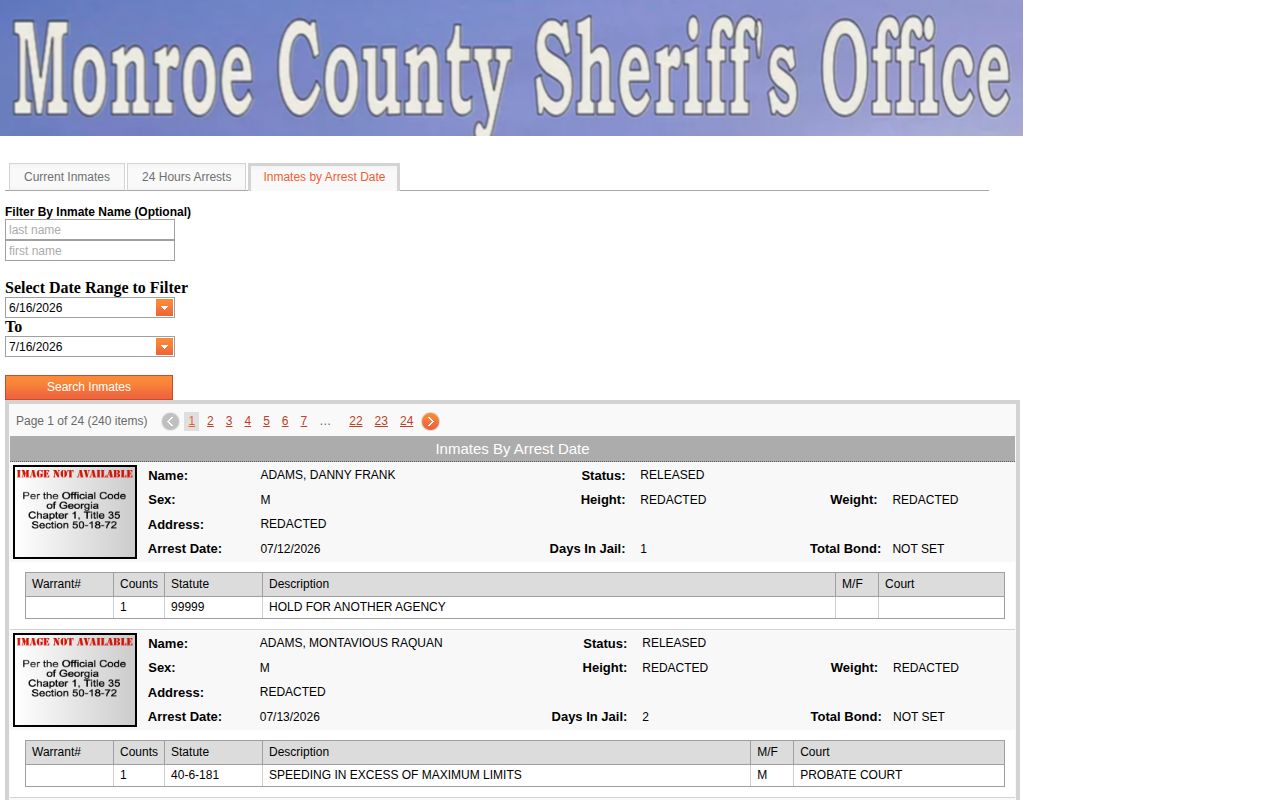
The image confirms why the source is useful for discovery but not exact release timing.
Monroe Weekend Release Checks
A three-day span helps around weekends because it groups several booking dates. Bond releases may occur outside office hours. Monroe says a bond can be made at any time, day or night, but that does not set a schedule for sentence completion, court-order release, transfer, or other outcomes.
Updates can cross midnight. Search an overlapping booking date when arrest occurred near a day boundary. Then compare status with court action or a VINE notice. Never infer release hour from days in jail.
Note: Holiday timing does not change the core limit because the tool filters by arrest date rather than release date.
Verify Monroe County Release Timing
Use the sheriff's Open Records Request for a formal three-day check or older event. Give a full name, birth date if known, arrest date, case or warrant number, and agency. Request release date and time, reason, bond, holding agency, transfer destination, and final custody status.
The Records Office is at 145 L. Cary Bittick Drive, Forsyth, GA 31029, phone (478) 994-7717, fax (478) 992-5075, and records@monroecosheriffga.us. The custodian responds within three business days with cost and completion estimates. O.C.G.A. 50-18-71 allows research charges, with none under 15 minutes. Payment follows an invoice.
VINELink may alert on release or transfer if registration occurred during active custody. A state transfer uses GDC. Federal and immigration cases use BOP or ICE. The Monroe County released-inmate search explains these boundaries.
Why Monroe Release Windows Mislead
Monroe's online sources track custody and bookings. The current roster answers who is held now. The 24-hour page covers recent bookings and can show released status. The date-range page searches arrest dates. None is a lasting release archive.
| Question | Source |
|---|---|
| Held now? | Current roster |
| Booked today and released? | 24-hour status |
| Booked in a chosen range? | Arrest-date feed |
| Exact release event? | Sheriff record |
A released person may next appear in a court disposition, GDC record after transfer, or parole and DCS records. Absence from jail proves none of those outcomes.
Monroe Release Alerts Beyond Feeds
The Georgia VINELink entry provides custody checks and notification registration for participating records. A notice prompts verification. It does not provide Monroe bond paperwork, full discharge fields, or court disposition.
Sheriff web and social references also mention inmate search and push-style features. They can ease navigation but do not create a verified 72-hour archive. Interop and the Records Custodian remain the official sources.
Request Monroe Three-Day Release Records
A records request should ask a focused question. Identify the person with full name, date of birth if known, arrest date, warrant or case number, and arresting agency. Then name the release fields needed. Useful fields include booking date, exact release date and time, release reason, bond, holding agency, transfer destination, and final custody status. The public feed does not display several of these items, so a request for the complete booking and release record avoids guessing from status alone.
The sheriff's response may distinguish bond, sentence served, court order, transfer, or another agency's hold. Each outcome means something different. Bond means the person left pending court. Transfer means county custody ended but another system may have begun. Sentence completion ends the specified confinement term but does not by itself answer whether supervision follows. Court records remain the source for disposition and later obligations.
If the Records Custodian provides a cost estimate, wait for the invoice rather than sending an assumed fee. Georgia's records rule ties research cost to the lowest-paid qualified employee, and the Monroe office states that payment is due before documents are released. The initial response deadline is not always the document delivery date. It can instead provide the estimated completion time and cost.
Monroe Releases Across Custody Systems
The county jail's three-day workaround applies only to Monroe bookings. A state-prison discharge from Burruss Correctional Training Center will not become a county release merely because Burruss is in Forsyth. Search that event through GDC, the State Board of Pardons and Paroles, and DCS. GDC records use state fields such as sentence dates and maximum release date. Parole records address release to supervision.
A federal release belongs in the BOP Inmate Locator. An immigration detention check belongs in ICE ODLS. Monroe also has an ICE 287(g) Jail Enforcement Model agreement, so release from local criminal custody should not automatically be described as release to the community when a transfer or detainer is involved. Ask for the final custody status and transfer destination if that distinction matters.
County, state, federal, and immigration tools do not share one three-day list. Follow the agency that held the person, then verify any handoff with the receiving system. That approach is slower than reading one roster, but it avoids turning a missing name into an unsupported claim.
Match Monroe Releases to Court Records
The jail charge grid identifies the court tied to each count. That record can explain why custody changed and what happened next. Monroe Superior Court handles felony jurisdiction, while Probate and Municipal entries may lead elsewhere. A release should be paired with the docket when bond, dismissal, plea, sentence, probation, or a later appearance is at issue. Jail status proves neither case completion nor the absence of a later warrant.
Use the warrant or case reference when contacting the clerk. This helps after a weekend, when custody status may update before court material is easy to locate. Keep the sheriff release response and court disposition separate because each documents a different event.
The court field also prevents a date-range search from becoming a name-only guess. Match the arresting agency, charge statute, and warrant or case reference before contacting the clerk. Superior Court handles felony matters in Monroe County, while Probate Court separately handles matters that include traffic cases. A clerk can explain the docket and provide available court records, but only the sheriff's release record establishes when local jail custody ended. Ask each office for the document it created and retain both responses with the booking details.
Public Record Search
Sponsored Results