
Monroe County 24-Hour Release Source
The Monroe County Sheriff's Office publishes an official Inmates Booked Last 24 Hours feed. Its label matters. The window is based on booking or arrest activity, not on the moment of release. A person booked during that span may carry either RELEASED or CURRENTLY BOOKED. The status line is the useful release clue. The page does not provide a separate release timestamp, a release reason, or a permanent archive.
A released entry means the person is no longer booked in that displayed county-jail event. It does not show whether release followed bond, a court order, time served, dismissal, transfer, or another agency's hold. The sheriff's detention information explains that local custody can end through bond, court disposition, completion of county time, or transfer into state custody. Those outcomes lead to different records.
Check Monroe County Same-Day Releases
Read the short-window feed as a set of recent bookings. Do not treat absence from the current roster as proof that release occurred. A transfer, spelling variation, delayed update, or move to another agency can also explain why a name is missing. Use the following order to produce an affirmative result.
- Open the sheriff's 24-hour booking feed and find the full name.
- Match the arrest date, arresting agency, charges, and court when names are similar.
- Read the status. RELEASED supports a county-jail custody change; CURRENTLY BOOKED means the person remained held when the feed updated.
- Check the current Monroe jail roster only to confirm current custody.
- Request the release date, time, reason, and destination when the public fields do not answer the question.
The broader Monroe County released-inmate search helps when the task is finding one named person across county, state, court, and federal systems. The same-day list instead answers who in a very recent booking set has already changed to released status.
Monroe County Release Feed Fields
The Interop result combines identity, booking, bond, charge, and court data. Several fields help distinguish similar names, but only the status directly indicates whether that displayed booking remains active.
| Field | What it means |
|---|---|
| Name and sex | Basic identifiers for the displayed person. |
| Status | RELEASED or CURRENTLY BOOKED for that booking result. |
| Arrest date and agency | When and by whom the arrest was recorded, not the release time. |
| Days in jail | A duration clue, not a formal discharge timestamp. |
| Total bond | An amount, not set, or denied. It does not prove that bond was posted. |
| Charge grid | Warrant number, counts, statute, description, level, and court. |
Height, weight, and address are redacted. Image elements may appear, but the sheriff states that booking photographs are not posted on its website under Georgia law. A formal release record may add the exact date and time, release reason, holding agency, transfer destination, and final custody status when requested.
The official 24-hour screen shows how status sits above the charge grid. That layout makes the status line more important than the bond total when deciding whether someone has left.
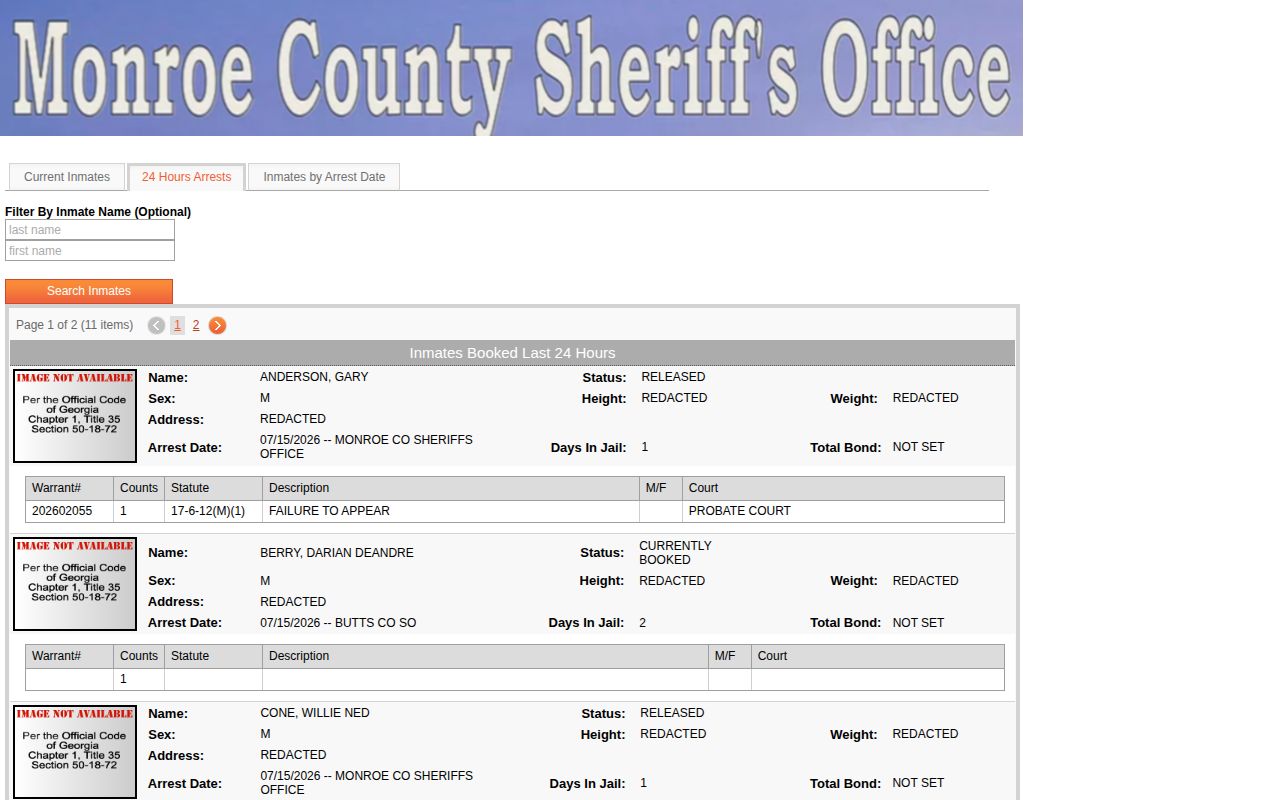
The captured screen reinforces the core limit: this is a short booking feed with release status, not a report sorted by release date.
Confirm Monroe County Release Records
When a person is outside the booking window or the release reason is needed, use the sheriff's Open Records Request. Give the full name, date of birth if known, arrest date, booking or warrant number, and the exact fields sought. Ask for booking date, release date and time, release reason, bond, holding agency, transfer destination, and final custody status.
The Records Office can be reached at (478) 994-7717, records@monroecosheriffga.us, or 145 L. Cary Bittick Drive, Forsyth, GA 31029. The custodian responds within three business days with an estimate of completion time and cost. Research fees follow O.C.G.A. 50-18-71, with no research charge when work takes less than 15 minutes. An invoice must be paid before documents are released.
Georgia VINELink can supplement the county record with a custody-change alert. The GDC offender search is the correct path only after a state transfer or state-prison sentence. A federal case uses the BOP locator, while ICE custody uses ODLS. The 72-Hour Releases page explains Monroe's longer arrest-date workaround.
Monroe Release Status Versus Custody
These systems answer different questions. The live roster shows who is presently booked. The 24-hour feed can preserve a released status briefly for a recent booking. Sheriff records document the local custody event after the short online window closes. Court records explain the case outcome, while GDC and parole records cover a state sentence or state supervision.
| Situation | Best Monroe channel |
|---|---|
| Still held at county jail | Current Interop roster |
| Recent county release | 24-hour feed, then sheriff records |
| State transfer or prison discharge | GDC offender search |
| Release on parole | Parolee search and DCS |
Bond release is not case completion. A person may leave jail pending court and still owe appearances. The charge grid names the relevant court, so the disposition should be checked there.
When Monroe Bond Releases Occur
The sheriff's bonding process says a bond may be made at any time, day or night, to release a person from the Monroe County Detention Center. That statement applies to bond-out access. It is not a promise that every release type is processed on a fixed round-the-clock schedule.
Monroe describes cash, property, professional, and transfer bonds and charges a $20 bonding fee for all bonds. Property bonds require qualifying Monroe County real property. Cash-bond return comes after final disposition and requires the county request form, certified final-disposition paperwork, and state identification. Jail staff do not recommend a bonding company. These details explain why a status may change quickly while the court case remains open.
The official bond page provides the source details shown below.
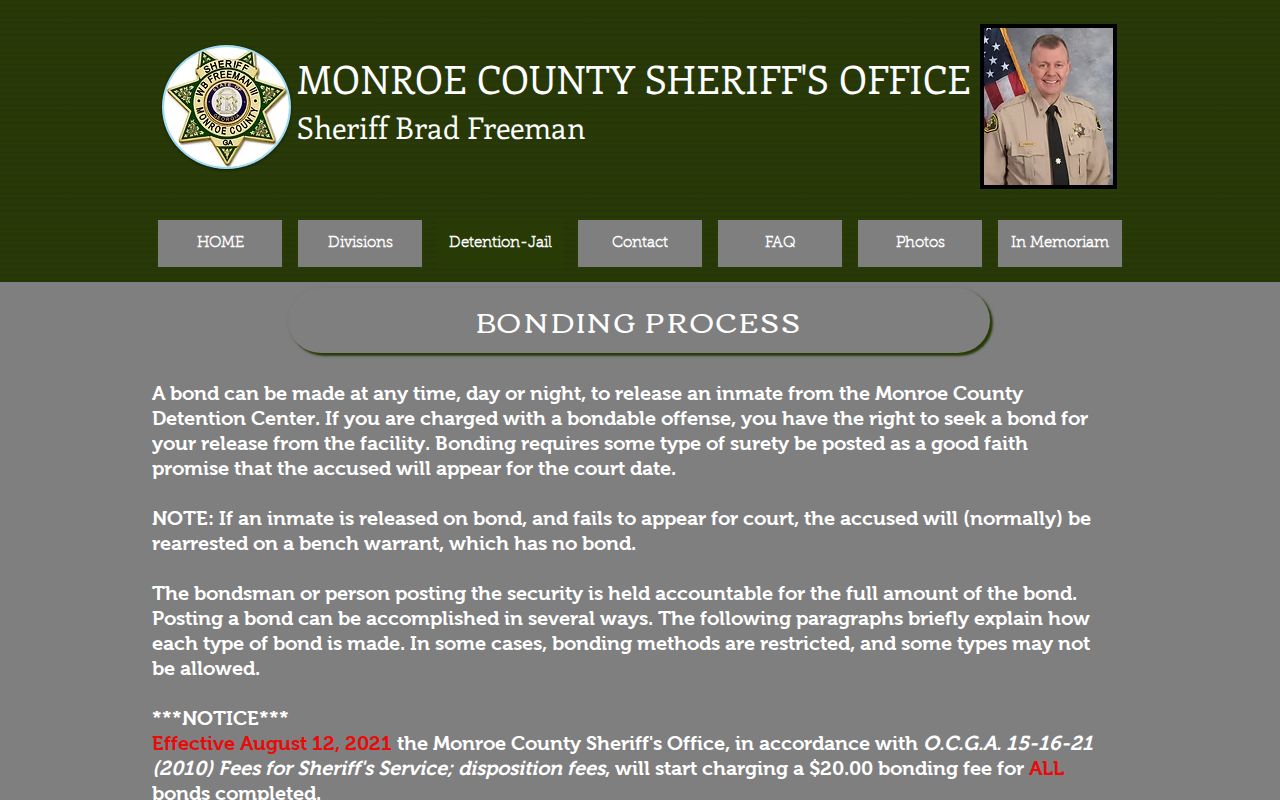
The bond source explains timing for one release path, while the release record remains the source for what actually happened in a specific booking.
Why Monroe Release Results Disappear
The short feed retains people because they were booked in the last 24 hours. It does not retain each person for 24 hours after release. Someone booked earlier and released today can therefore be absent. The arrest-date search may find an older booking, yet it still does not sort by release date or provide a formal release timestamp.
MCSO web and social references mention inmate search and push-notification features. Treat those as convenient navigation or alert channels. The Interop feed and sheriff records process remain the official anchors for the result and its proof.
Note: A missing name is inconclusive until an affirmative release status, records response, court action, or transfer record confirms the change.
Monroe Release Records After Bond
A same-day bond release ends physical jail custody but leaves the case open. The Interop charge grid may name Superior, Probate, or Municipal Court. Follow that court reference for later disposition, sentence, probation terms, or a failure-to-appear issue. A bond total shows an amount or restriction, not proof that payment occurred or that each court condition was met.
When requesting records, distinguish custody from court action. The release record answers when and how jail custody ended. Certified court papers answer what happened to the charge. If the person moved to GDC, the statewide offender record becomes the next custody source. Keeping those records separate prevents a brief RELEASED label from being mistaken for a finished case.
Monroe court contacts also help separate similar bookings. Superior Court has felony jurisdiction, while a traffic-related entry may lead to Probate Court and a city matter may point to Municipal Court. Use the court name, warrant number, statute, and arrest date from the jail grid when asking a clerk about the matching case. The clerk can confirm docket events, but the sheriff remains the source for the time and reason local custody ended. If bond paperwork is needed, request that document by name instead of asking only for an inmate record.
Public Record Search
Sponsored Results